
Simon Ward reviews Derry Boys at Theatre503
This piece comes closest to my own personal experience of anything I have reviewed in all my years writing for The Peg. Though I wasn’t born there, I was raised in Derry, so I would almost certainly qualify for entry to the Derry Boys club, should anyone be foolish enough to invent such a thing. As a city it is a microcosm of Northern Ireland’s conflicted and contested history – literally split in two by the broad river Foyle where the majority Catholic population are largely on one side and the Protestant population mainly on the other. There is not even any consensus on the name, as evidenced by the endlessly grafitti-ed roadsigns. The sign-makers think the place is called Londonderry; hundreds of youths with spray cans of paint would beg to differ. And, of course, for many years it was ravaged by the violence of what was euphemistically called ‘The Troubles’.
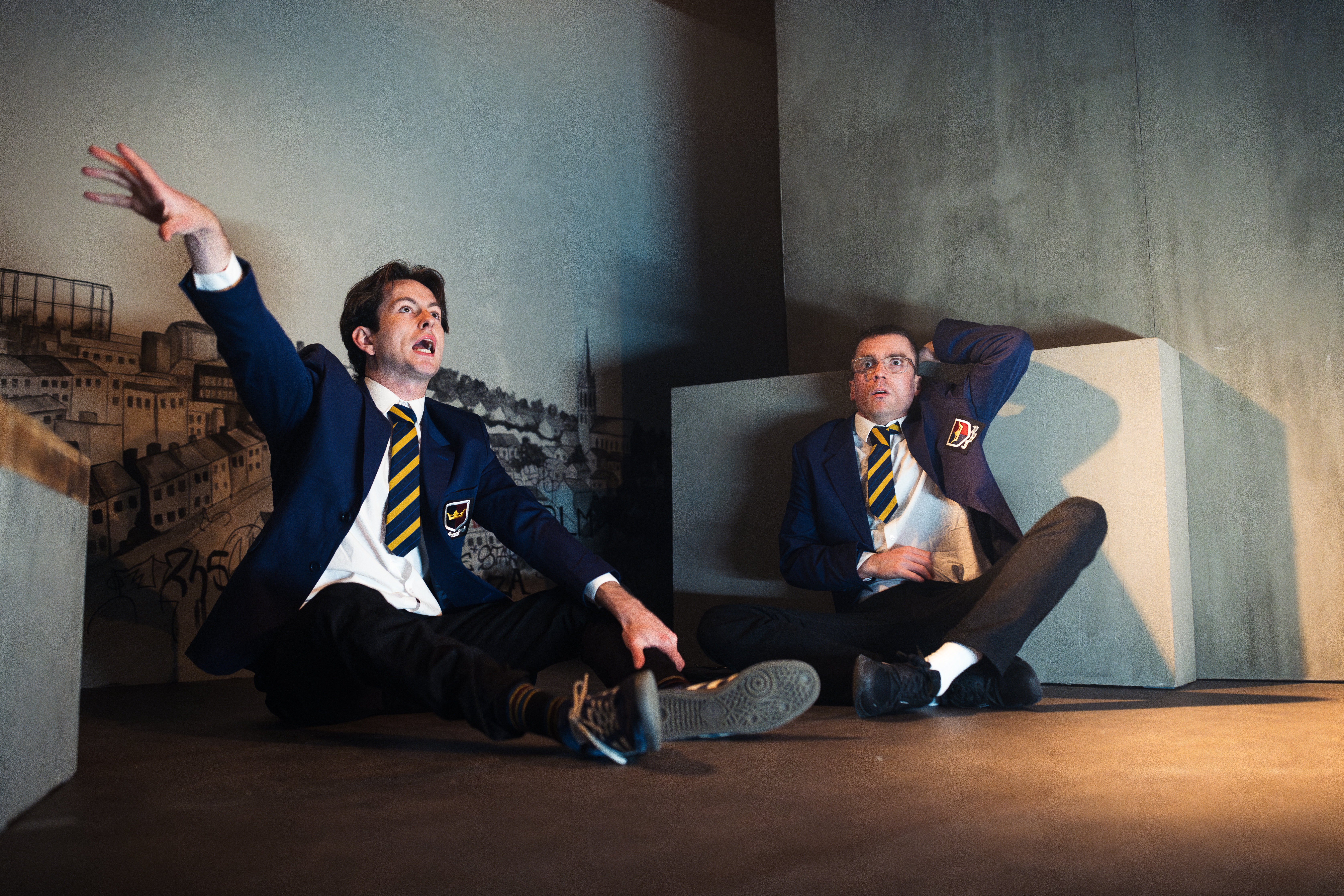
The protagonists of Niall McCarthy’s debut full-length play were not witnesses to the violence – they are of the post-Good Friday Agreement generation, for whom the horrors of the past were supposed to be a distant memory consigned to history. Yet, for best friends Paddy (Eoin Sweeney) and Mick (Matthew Blaney), Derry is still a challenging place in which to grow up and make a future. Society is still divided along sectarian lines. Schoolwork seems irrelevant and pointless when the prospect of getting a decent job at the end seems so remote. Even Pizza Hut is closing down. The magnetic pull of England as a land of greater opportunity is as strong as ever. And also, ironically, the Troubles from which they have been saved have acquired a romantic glamour – how much cooler to be fighting for freedom than stuck in endless detentions in school.
Against this backdrop Paddy and Mick forge a fast friendship at school which they believe can withstand anything. They both come from troubled families – fathers away working much of the time, mothers absent or distant – which probably explains the depth of their bond. They turn to each other when they are in trouble. Paddy’s growing relationship with Aoife (Catherine Rees) is a challenge to the bromance – she doesn’t think much of Mick, but can see potential in Paddy – yet it doesn’t break it. But when the rift does finally come, it will be painful and cut deep.

Caitlin Abbott’s set design is cleverly versatile and director Andy McLeod ensures that the choreography of shifting pieces adds to our understanding of the characters. McCarthy writes wittily, and often hilariously, on the many absurdities of everyday life in Northern Ireland, but is heartfelt on the educational segregation that means the two communities rarely form the bonds that Paddy and Mick do. He asks searching questions, too, about loyalty, duty and patriotism. He acknowledges his debt to Lisa McGee’s Derry Girls but has produced a worthy companion piece. Any play set in Derry will be full of wisecracking humour. McCarthy’s achievement is to incorporate that seamlessly into a moving and powerful work.
Derry Boys is running at Theatre503, 503 Battersea Park Road, London SW11 3BW until Saturday 7th June
 Explore All Our Reviews
 THE PEG