
Simon Ward reviews Synchronicity at the White Bear Theatre
If you emerge from Arthur I. Miller’s play feeling like you’ve had an intellectual workout, it probably won’t surprise you to learn that Miller is Emeritus Professor of History and Philosophy of Science at University College London, and this is his first foray into the world of theatre. This is a piece crammed full of ideas, but the ample running time of around two hours with interval means that they have room to breathe.
The plot is based on the real-life relationship between the famous analyst Carl Jung (Stephen Riddle) and the theoretical physicist Wolfgang Pauli (Jeremy Drakes). When they first meet, in 1931, Pauli is in his early thirties, a brilliant young university professor but deeply troubled. He describes himself as the living embodiment of Jekyll and Hyde. So, in desperation, he turns to Jung for help. Stephen Riddle gives us a picture of Jung as an old-fashioned schoolmasterly type – he insists on being in control in the face of Pauli’s outbursts. Underneath the surface, he too has lurking demons, but nothing disturbs the outward composure. Jeremy Drakes, on the other hand, has no qualms about sharing the unsettling madness Pauli feels, nor the irritation at having to play an unaccustomed subordinate role as patient.
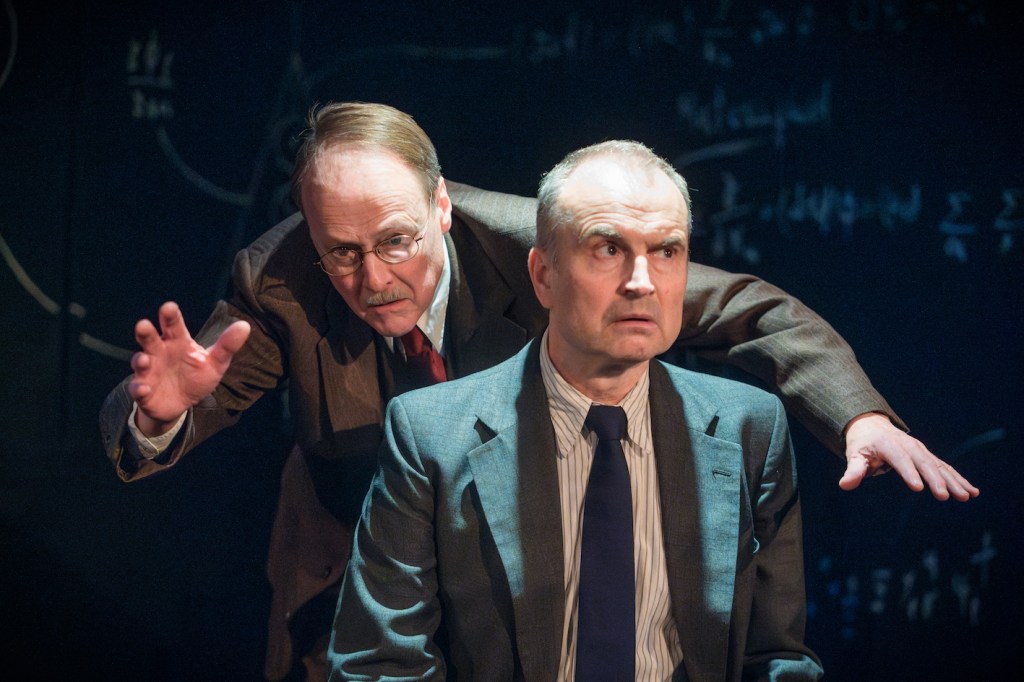
The play unfolds over the course of their encounters – what starts as a therapist-patient relationship transforms over time as Pauli’s mental health begins to improve, and the pair become friends and collaborators. Pauli begins to see similarities and connections between his own work and Jung’s theories – particularly around the ideas of archetypes and synchronicity.
There is no getting away from the fact that the play is rather static – most of the action consists of two men sitting in chairs discussing their ideas. Director Anthony Shrubsall works hard to break this up as much as possible – there are occasional soliloquies where they each reveal even more of their inner selves – and moments of animation as the real world occasionally intrudes. There is nevertheless a problem with the format as time elapses – at first the sessions are weekly so everything being set up the same makes sense. When there are bigger gaps in time – months, then years – it would help to add some more visual cues to indicate this – whether in the set or makeup – rather than rely simply on rather clunky exposition. Missing, too, is the drama of the outside world. For example, as someone with Jewish heritage, Pauli is forced to flee to America to escape the Nazis – the necessity for this is discussed in the same tone as debates about dreams and mandalas. And, on his return years later, when the war is over, barely a mention. The human factor, in this regard at least, is lost.
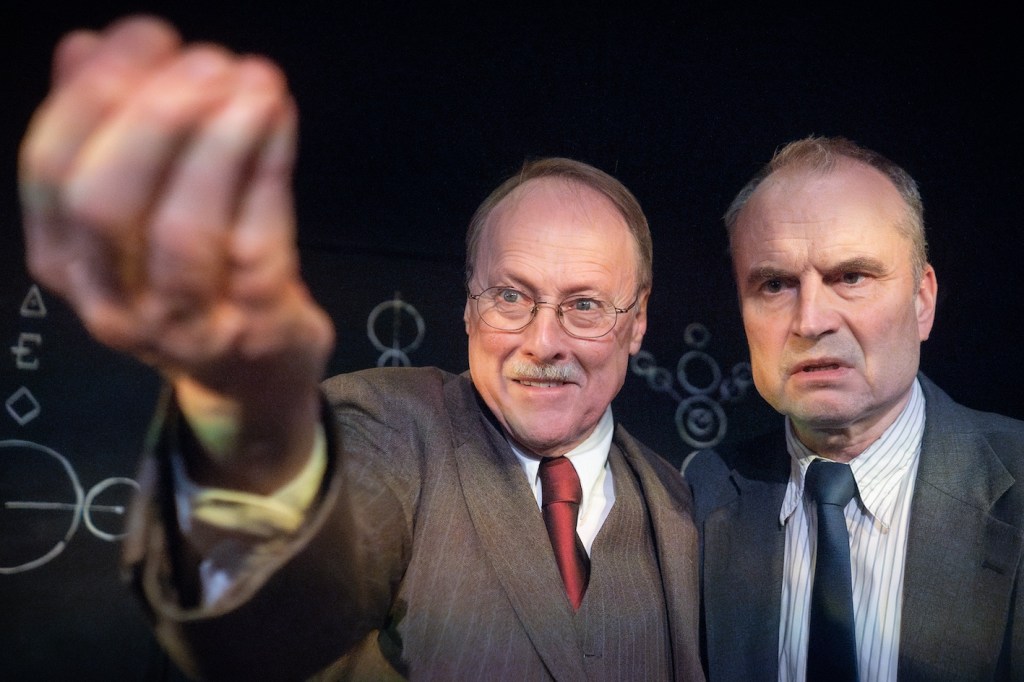
However, this is above all a play of ideas, and you will likely emerge from the theatre with your head buzzing, resolving to read more about these two fascinating men and their writings. The play itself can be seen as embodying some of the ideas the men espouse. We gradually come to realise that in some ways each of these men themselves represent a kind of masculine archetype – men brilliantly successful in their working lives who are somehow drawn to self-destructive ‘womanising’ and/or alcohol abuse. The meeting of the two men in the first place could be considered an example of Jungian synchronicity. A play that gets you thinking is no bad thing.
Synchronicity is running at the White Bear Theatre, 138 Kennington Park Road, London SE11 4DJ until 30th November.
 Explore All Our Reviews
 THE PEG